COTABATO CITY — The deployment of three Army divisions for the September 14 parliamentary elections underscores both the importance of the Bangsamoro vote and the security challenges that continue to shadow the region’s transition from armed conflict to democratic governance.
The Army’s 4th, 6th and 10th Infantry Divisions are coordinating operations to support the Commission on Elections and secure polling sites in 44 towns across Central Mindanao.
The extensive military coordination is a reminder that elections in the Bangsamoro carry significance beyond the usual contest for political office. The vote will help determine whether the region’s long and difficult transition toward a more permanent autonomous government can continue through democratic institutions rather than armed struggle.
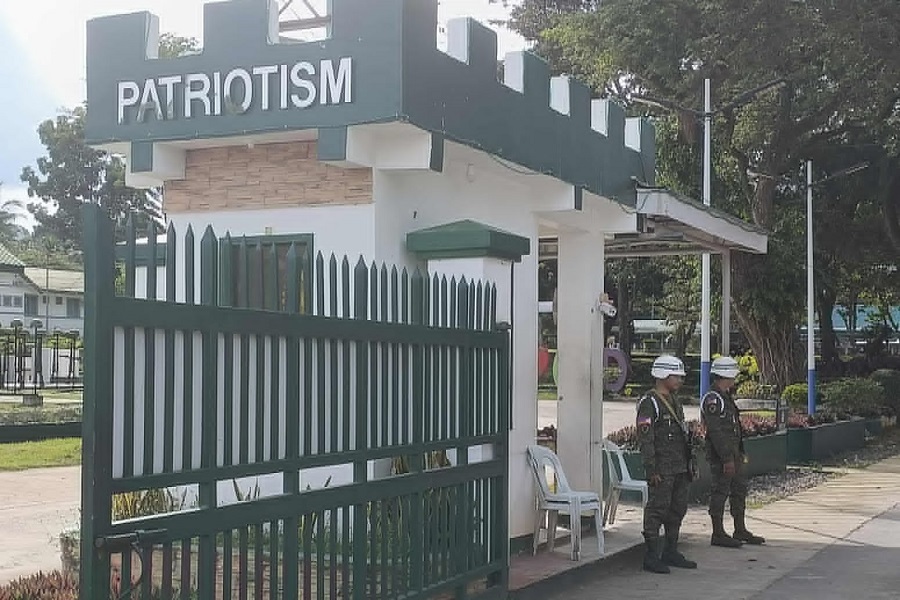
Major Gen. Marion Angcao, commander of the 4th Infantry Division, met on August 29 with Brig. Gen. Ricky Bunayog, commander of the 6th Infantry Division, and Brig. Gen. Edgar Catu, the division’s deputy commander, at Camp Siongco in Datu Odin Sinsuat, Maguindanao del Norte.
Their discussions focused on security arrangements and the ability of military forces to respond quickly to potential threats during the elections.
The 6th Infantry Division, based at Camp Siongco, bears much of the responsibility for securing some of the election’s most important areas. Its area of responsibility includes Maguindanao del Norte and Maguindanao del Sur, as well as the eight towns of the Bangsamoro Special Geographic Area in Cotabato province.
Together, the two Maguindanao provinces account for 34 towns — 12 in Maguindanao del Norte and 22 in Maguindanao del Sur.
The 4th Infantry Division, headquartered in Cagayan de Oro City, has deployed troops to reinforce the 6th ID in the two provinces and the Bangsamoro Special Geographic Area.
The 10th Infantry Division, based in Mawab, Davao de Oro, is also contributing personnel. Its commander, Major Gen. Alvin Luzon, said troops from the division had been integrated with the Army’s 602nd Infantry Brigade in the Bangsamoro Special Geographic Area for election security duties.
The involvement of forces from outside the immediate area reflects the scale of the operation. It also illustrates how seriously the government views the need to prevent violence, intimidation or other disruptions that could undermine public confidence in the election.
“All is well with our security preparations for the September 14 Bangsamoro regional elections,” Bunayog said. “The 4th Infantry Division and the 10th Infantry Division are both supporting it.”
But the success of the election will ultimately be measured by more than the absence of violence.
More than 10 political parties have been permitted by the Commission on Elections to field candidates for the 80-seat Bangsamoro Parliament. The challenge is not simply to deliver ballots and protect polling centers, but to ensure that voters can make their choices freely and that the results are accepted as credible.
In Cotabato City, the regional capital, polling sites will be secured jointly by the 6th Infantry Division, the Navy’s 6th Marine Battalion, the Cotabato City Police Office and the Police Regional Office-Bangsamoro Autonomous Region.
The multi-agency security arrangement reflects a broader recognition that no single institution can guarantee a peaceful election. Military forces, police, election officials and local governments must work together — while ensuring that security measures themselves do not interfere with the civilian character of the democratic process.
Military officials said the August 29 coordination meeting at Camp Siongco focused on identifying potential security challenges and establishing procedures for responding to them under the supervision of the Commission on Elections.
Angcao and Bunayog also cited the support of local government officials and Bangsamoro regional leaders for the security preparations.
That cooperation will be crucial. Security in the Bangsamoro cannot rest on soldiers alone. A peaceful election also depends on political leaders who restrain their supporters, candidates who respect the rules and communities that reject violence as a means of settling political disputes.
The Bangsamoro Autonomous Region in Muslim Mindanao was established in 2019 as the result of years of peace negotiations between the Philippine government and Moro communities. It replaced the Autonomous Region in Muslim Mindanao, which had existed for 27 years but was widely seen as having limited political and institutional powers.
The creation of BARMM represented an attempt to address a conflict that had lasted for generations. Its promise was that greater autonomy, representative institutions and political participation could provide an alternative to the cycles of violence that had shaped much of Mindanao’s recent history.
The September 14 election is therefore part of a larger test.
It will determine the members of the 80-seat Bangsamoro Parliament and test the strength of the institutions created by the peace process.
Elsewhere in the region, the Army’s 1st Infantry Division, the Police Regional Office-Bangsamoro Autonomous Region and other units under the Western Mindanao Command will oversee security in Lanao del Sur, Basilan, Tawi-Tawi, Lamitan and Marawi.
The heavy security preparations should not, by themselves, be interpreted as a sign that violence is inevitable. Rather, they reflect the state’s responsibility to protect an election, with consequences far beyond a single day of voting.
For the Bangsamoro, a peaceful and credible election would be more than an administrative success.
It would be another indication that political differences can increasingly be settled at the ballot box — and that the democratic institutions envisioned by the peace process are beginning to take deeper root.
About The Author