
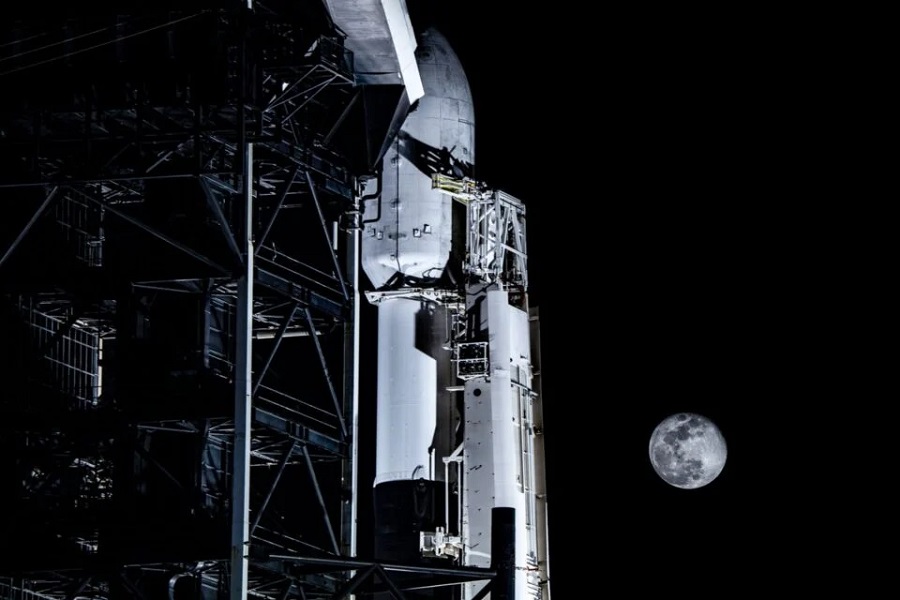
The SpaceX rocket stands on the launch pad beneath a full Moon before carrying Blue Ghost Mission 1 in January 2025 © SpaceX.
A spent SpaceX rocket stage that has wandered through space since a lunar mission in January 2025 is now expected to collide with the Moon this summer, according to an independent astronomer who has tracked its unusual orbit for months.
Bill Gray, an orbital analyst and creator of the Project Pluto tracking software, said the Falcon 9 upper stage is projected to slam into the lunar surface on Aug. 5 at roughly 5,400 miles per hour, or about seven times the speed of sound. Gray expects the impact to occur at 2:44 a.m. Eastern time.
The rocket poses no danger to Earth, Gray said, but its path has renewed concerns among astronomers about the growing accumulation of space debris beyond the planet.
“It doesn’t present any danger to anyone,” Gray wrote on the Project Pluto website, “though it does highlight a certain carelessness about how leftover space hardware is disposed of.”
The Falcon 9 rocket launched on Jan. 15, 2025, from NASA’s Kennedy Space Center carrying two commercial lunar landers: Firefly Aerospace’s Blue Ghost and ispace’s Resilience. Blue Ghost later achieved a successful lunar landing and transmitted striking images of the sun setting over the Moon before shutting down as planned. Resilience, however, crashed during its landing attempt.
The rocket’s upper stage — the portion that pushed the landers toward the Moon — should have returned to Earth’s atmosphere and burned up after deployment. Instead, it became stranded in a highly elliptical orbit stretching deep into cislunar space, the region between Earth and the Moon.
Gray said astronomers have collected more than 1,000 observations of the object since February, allowing them to map its unusual trajectory with increasing precision. The rocket now circles Earth every 26 days in a lopsided orbit that ranges from about 137,000 miles from Earth at its closest approach to roughly 310,000 miles at its farthest point.
“The orbit of the Moon and of this object, roughly speaking, intersect,” Gray said. “Usually, one goes through the intersection point while the other is someplace else. But on August 5, they’ll reach that point at the same time.”
Current calculations indicate the rocket will strike the Moon’s near side, although Gray said the exact impact site could shift. By the time of impact, he expects astronomers will be able to predict the location within a few dozen meters.
Despite the dramatic collision, scientists do not expect the crash to cause significant damage to the lunar surface. The Countless natural and human-made impacts have already marked the moon.
The event is also unlikely to be visible from Earth. In 2009, NASA intentionally crashed a rocket stage into the Moon during the LCROSS mission in an effort to detect water ice, but even then telescopes struggled to observe the impact plume.
Still, the incident has become another example of the mounting challenges posed by space debris as commercial and government launches accelerate worldwide.
In recent years, scientists and environmental researchers have raised alarms about the increasing number of abandoned rocket stages and satellites orbiting Earth. While most objects burn up harmlessly during reentry, some debris has survived descent and landed in populated areas, occasionally damaging homes.
Gray said that, in this case, the Moon is a far safer destination than Earth.
“Better the Moon than us,” he suggested.
For astronomers, however, the wandering Falcon 9 stage has become an unusual scientific spectacle — a piece of discarded machinery tracing a slow-motion collision course through the Earth-Moon system, one that researchers will continue monitoring until the moment it disappears into the lunar surface.
About The Author


