
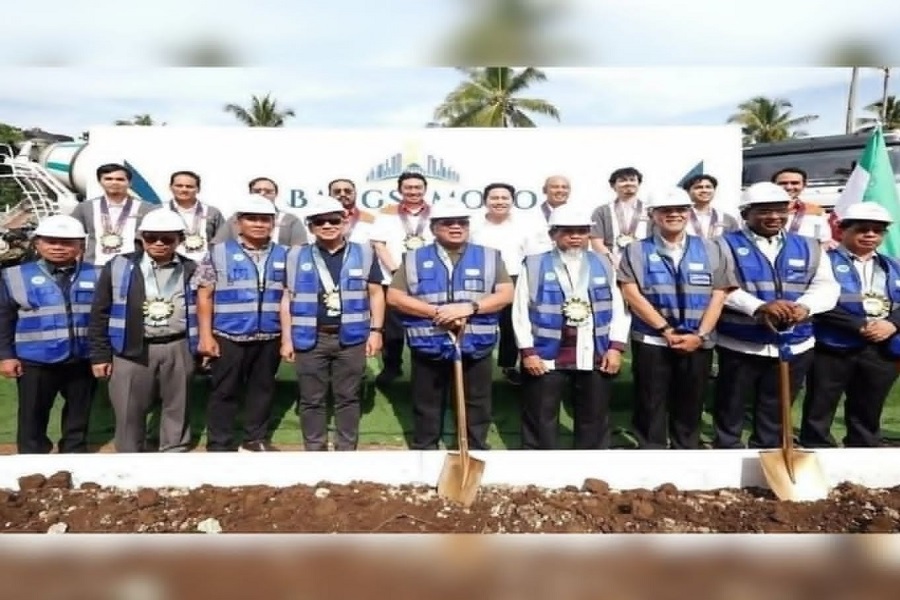
The symbolic launching of the Bangsamoro regional government center in Parang, Maguindanao del Norte was witnessed by representatives from various sectors and leaders of the Muslim, Christian and indigenous non-Moro communities in the province. (John Unson)
COTABATO CITY — A sprawling P30 billion government complex is rising in a seaside town in Maguindanao del Norte, promising to transform one of the Bangsamoro region’s longtime political strongholds into a magnet for investment and economic activity.
Officials on Thursday, August 13, formally launched construction of the Bangsamoro regional government center in Barangay Landasan, Parang — a project local leaders say could send a powerful signal to businesses that the once conflict-ridden area is ready for a new chapter.
The ambitious development will bring together regional offices now scattered inside the 32-hectare former capitol complex of the defunct Autonomous Region in Muslim Mindanao in Cotabato City, about 30 kilometers away.
Since the creation of the Bangsamoro Autonomous Region in Muslim Mindanao (BARMM) in 2019, most of its ministries and support agencies have operated from the old ARMM government center.
Now, the Bangsamoro government is preparing to build a permanent administrative heart of its own.
The launch in Parang was led by Bangsamoro Chief Minister Abdulraof Macacua, members of the 80-seat Bangsamoro Parliament and other dignitaries, including Malaysian Ambassador to the Philippines Dato’ Abdulmalik Melvin Castileno and representatives from the office of President Ferdinand Marcos Jr.
Malaysia’s presence carried particular significance.
The country played a key role in brokering the final peace agreement between the Philippine government and the Moro Islamic Liberation Front (MILF) after more than two decades of negotiations.
That peace process ultimately paved the way for the replacement of the 27-year-old ARMM with the more powerful BARMM in 2019.
For local officials, the new government center represents far more than offices and concrete.
It is being billed as a potential economic game-changer.
Parang Mayor Cahar Ibay, Maguindanao del Norte Vice Gov. Marshall Sinsuat and BARMM parliament member Ishak Mastura separately told reporters that the project could accelerate development in communities surrounding Landasan, benefiting both Moro and non-Moro residents.
Mastura, a lawyer who previously served as ARMM trade and investment secretary, said the presence of a major regional government complex could give investors greater confidence in the area.
“That will improve the investment potentials of Parang and nearby towns. We want that project done without delay.”
He said the development could help convince businesses from outside the province that it is safe to establish major investments around the government center.
Macacua said the project will be built in two phases, with each phase carrying a price tag of P15 billion, bringing the total cost to P30 billion.
“We are confident that this project will be accomplished according to an implementation timeframe plotted by engineers,” the chief minister said.
For Sinsuat, however, the project carries a deeper meaning.
The vice governor, who was elected only last year, said he and community leaders in his hometown of Datu Blah Sinsuat welcome the development as a symbol of the long and painful struggle for Moro self-determination.
“For us, that is something paid for with the lives of the members of the Moro Islamic Liberation Front and the Moro National Liberation Front who perished in their bloody uprising for Moro autonomy under Philippine sovereignty,” Sinsuat said.
The MILF and Moro National Liberation Front (MNLF) fought separate armed struggles for greater autonomy in Mindanao before entering into peace agreements with the national government.
Both groups now have representatives in the 80-member BARMM Parliament, while their members are also involved in administering various agencies under the Bangsamoro government.
For a region shaped by decades of conflict, the construction of a P30 billion government center therefore carries a striking symbolism.
The very institutions that once struggled to negotiate peace are now preparing to put down permanent roots — with local officials hoping that the government complex will bring not only bureaucracy, but jobs, businesses and investment to the communities around it.
About The Author