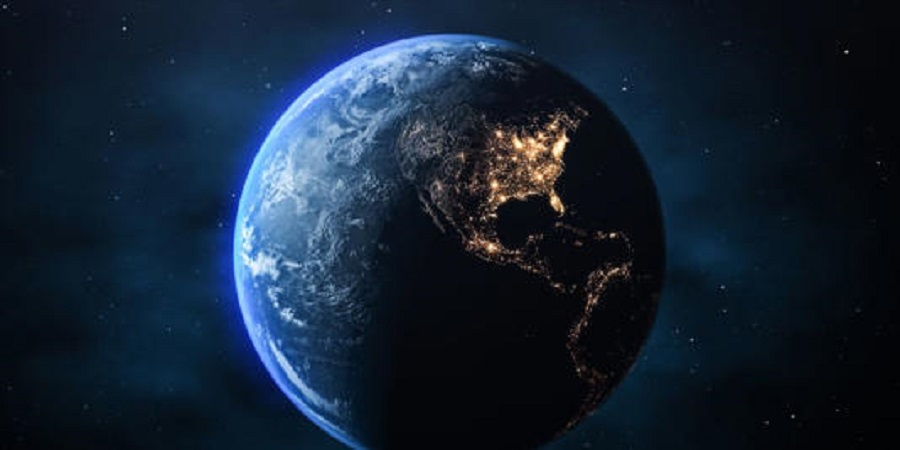

Deep in the Indian Ocean lies one of Earth’s most peculiar phenomena — a vast “gravity hole” where the planet’s gravitational pull is astonishingly weak. This strange anomaly, technically known as a geoid low, creates a dent in Earth’s gravitational field so profound that sea levels in the area are 348 feet (106 meters) lower than the global average.
Discovered in 1948, this 1.2-million-square-mile (3.1 million square kilometers) region sits about 746 miles (1,200 kilometers) southwest of India.
For decades, its origins puzzled scientists, with theories ranging from tectonic quirks to mantle mysteries. Finally, in 2023, researchers uncovered the answer using cutting-edge computer simulations.
A Journey Through Deep Time
To solve this riddle, geophysicists turned back the clock, simulating 140 million years of tectonic plate movements and mantle dynamics across 19 computer models.
The key to the gravity hole’s formation lay in an ancient ocean called Tethys, which existed between the supercontinents Laurasia and Gondwana. When Gondwana began breaking apart 180 million years ago, chunks of Tethys’ crust were forced beneath the Eurasian plate.
These fragments plunged deeper and deeper into Earth’s mantle, and around 20 million years ago, they reached the mantle’s lowermost regions. There, the sinking fragments displaced dense material tied to the so-called “African blob” — a towering mass of crystallized magma beneath Africa that is 100 times taller than Mount Everest. In response, lighter magma from surrounding regions rose to fill the void, reducing the area’s overall mass and weakening its gravitational pull.
The Blob Connection
Far from being an isolated curiosity, the Indian Ocean gravity hole hints at a fascinating underground world. Earth’s mantle is riddled with mysterious “blobs” of magma — some dense and others surprisingly buoyant. The African blob’s role in this story has come to light, but there are still lingering questions.
Scientists aim to confirm their models with earthquake data, which could reveal more about the low-density plumes beneath the gravity hole.
And Earth isn’t the only planet with such mysteries. Mars, too, harbors its share of underground blobs, adding to the growing realization that planetary interiors are far stranger and more complex than once imagined.
The Indian Ocean gravity hole isn’t just a dent in Earth’s gravitational field — it’s a portal to understanding the dynamic, hidden forces that shape our planet and others in the cosmos.
About The Author