
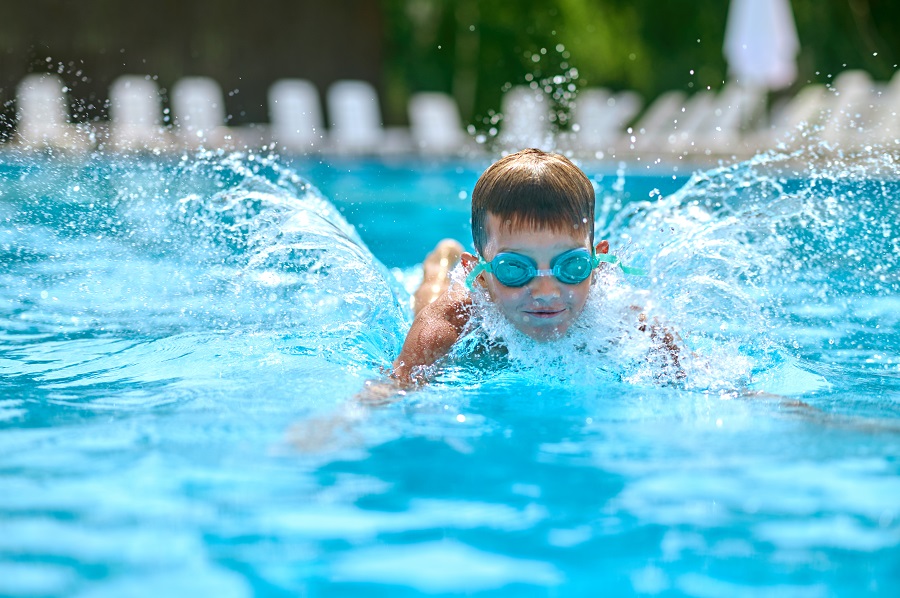
More Filipino parents are teaching kids to swim early—boosting safety, confidence, and life skills as drowning risks remain high. (Image by freepik)
Summer has always meant beach trips and pool days for many Filipino families. But more parents today are turning those moments into something more intentional: teaching their children how to swim as early as possible.
For 45-year-old Cebuana Geraldine P. Gulle, the decision was both practical and deeply personal.
“We wanted her to learn life-saving skills; at the same time, we were also concerned about water safety,” she said. “Knowing how to swim gives her the ability to protect herself while enjoying the water.” Her daughter, 8-year-old Amber Brielle, has loved the water since she was 5. What began as a simple plan to enroll her in summer swimming lessons quickly became a long-term investment in safety and confidence.
“It all started after she completed her first school year. We knew children naturally enjoy being in water at an early age,” Gulle recalled. “For her to fully and safely enjoy it, learning to swim was essential.”
From play to protection
Across the Philippines, more parents are starting to value swimming. It is not only a recreational activity. But as a life skill, especially in a country surrounded by water.
For Gulle, the results went beyond safety. “It not only promotes safety in and around water but also gives children confidence,” she said. “We noticed a big boost in her confidence and more willingness to try new things.”
The physical benefits were just as evident. Once frequently ill, Amber Brielle has grown stronger and more active through regular swim training.
Building confidence early
The idea of introducing children to water at a young age can be daunting, especially for parents whose kids are initially afraid. But structured lessons, Gulle said, are designed to ease that fear.
“It’s normal to feel hesitant at first,” she said. “But swimming lessons build comfort gradually. You’ll be surprised at how quickly children adapt when they feel supported and safe.”
Her advice to other parents: start early. “Enrolling in swimming lessons is an investment in a lifetime skill and safety,” she said. “Start them early and see the progress.”
Small strokes, big milestones
What began as a safety measure has also opened doors for Amber Brielle to compete in local swim meets. She earned bronze and silver medals at the Liloan District Meet in November 2025, and gold and bronze at the Valentine’s Swim Fest in Cebu City in February 2026.
Still, for Gulle, the real reward isn’t the medals. “It’s one less fear as parents,” she said. “Knowing she has learned this skill that can help keep her safe.”
A response to a real risk
The growing interest in early swim education also reflects a sobering reality: drowning remains a leading cause of injury-related deaths in the Philippines, particularly among children.
Health officials warn that risks increase during summer, when more families flock to beaches and pools.
Dr. Shelbay G. Blanco of the Department of Health in Central Visayas describes drowning as a major but often underreported public health issue. “Anyone can drown, but no one should,” Blanco said, stressing that most incidents are preventable.
Children aged 1 to 4 are especially vulnerable due to lack of supervision, while adolescents—particularly boys—face risks linked to curiosity and risky behavior.
The ‘5Bs’ of water safety
To help families stay safe, the Department of Health promotes the “5Bs” of drowning prevention:
- Bantayi (Supervise): Always keep a close eye on children
- Bida Salbabida (Use flotation devices): Use life vests or floaters, even for swimmers
- Barriers: Follow safety zones and install protective barriers at home
- Bawal ang alkohol: Avoid alcohol while swimming
- Bystander intervention: Learn rescue skills, including CPR
Blanco emphasized that even children who can swim should use flotation devices in deeper waters, and that knowing CPR can make a critical difference in emergencies.
A shared responsibility
Preventing drowning is not just a family concern—it requires collective action.
The Department of Health continues to work with local governments, tourism establishments, and communities to strengthen safety measures, including training lifeguards and expanding access to first aid and CPR training.
“It’s not just the role of government,” Blanco said. “It should involve everyone—the community, private organizations, and families.”
Starting sooner, staying safer
As more Filipino parents embrace early swim education, a shift is taking shape—from swimming as a seasonal pastime to a lifelong skill.
For families like the Gulles, it begins with a simple decision but carries lasting impact: giving children the confidence to enjoy the water—and the skills to survive it.
About The Author