
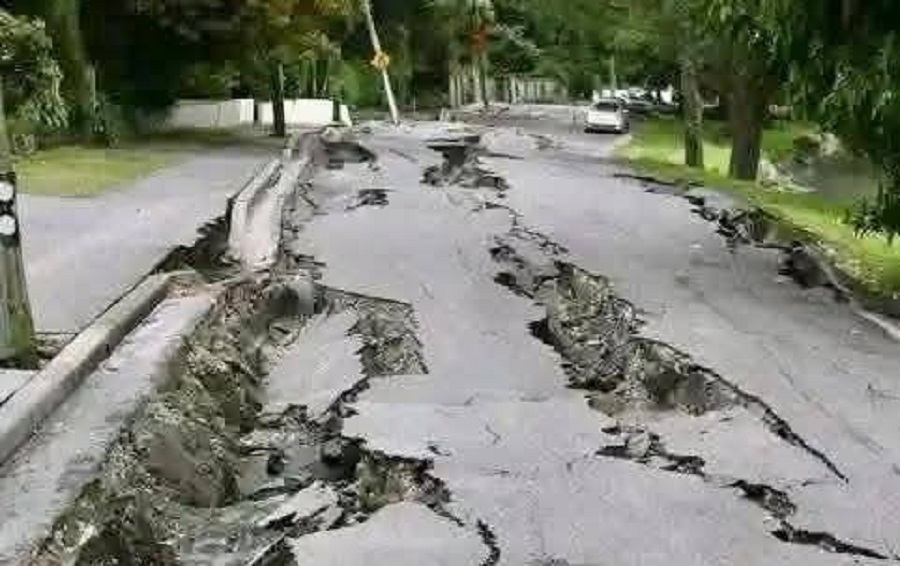
A powerful magnitude 7.6 earthquake struck off Mati City, Davao Oriental on Friday morning, shaking large parts of Mindanao and Visayas and triggering brief tsunami warnings. The tremor, recorded at 9:43 a.m. on October 10, was located at 07.09°N, 127.09°E, about 62 kilometers southeast of Manay, with a depth of 10 kilometers, according to the Philippine Institute of Volcanology and Seismology (PHIVOLCS).
The quake came just ten days after a magnitude 6.9 earthquake hit offshore northern Cebu near Bogo City on September 30, prompting some to ask: are the two quakes related?
Part of the same tectonic reality
The Philippines sits within the Pacific Ring of Fire, a volatile zone where several tectonic plates—including the Philippine Sea Plate and the Eurasian Plate—collide. These interactions constantly build stress along fault lines, making earthquakes a regular part of the country’s geological life.
According to PHIVOLCS, both the Cebu and Davao Oriental earthquakes occurred within the same broad tectonic regime, but on different fault systems.
“There is no direct connection between the two events,” PHIVOLCS said in its advisory. “The earthquakes originated from separate local faults and are independent of each other.”
Why experts rule out a link
Seismologists explain that while one large quake can sometimes trigger another, that usually happens only when the faults are close together—either in space or in shared stress zones.
“The distance between northern Cebu and Davao Oriental is too far—over 400 kilometers—for stress transfer to cause triggering,” said Dr. Renato Solidum Jr., Secretary of the Department of Science and Technology and former PHIVOLCS Director. “The time gap of ten days also makes a direct cause-and-effect relationship improbable.”
In simpler terms, the Cebu quake and the Davao quake are not twins—but distant cousins in the same restless geological family that shapes the Philippine archipelago.
A reminder of a restless land
The October 10 Davao Oriental quake was one of the strongest in the region in recent years, prompting tsunami alerts along the eastern seaboard of Mindanao and parts of the Visayas. Fortunately, PHIVOLCS later lifted the warning after no significant sea level disturbances were observed.
Still, the twin events—Cebu and Davao—underscore how the Philippines remains one of the most seismically active countries in the world, with about 20 earthquakes recorded daily, most too weak to be felt.
Preparedness as the only connection
Whether or not the two events are related geologically, they share one crucial message: the need for preparedness.
“Earthquakes don’t need to be connected to remind us that we must always be ready,” Solidum said. “Every quake is a test of how much we’ve learned from the last one.”
About The Author