
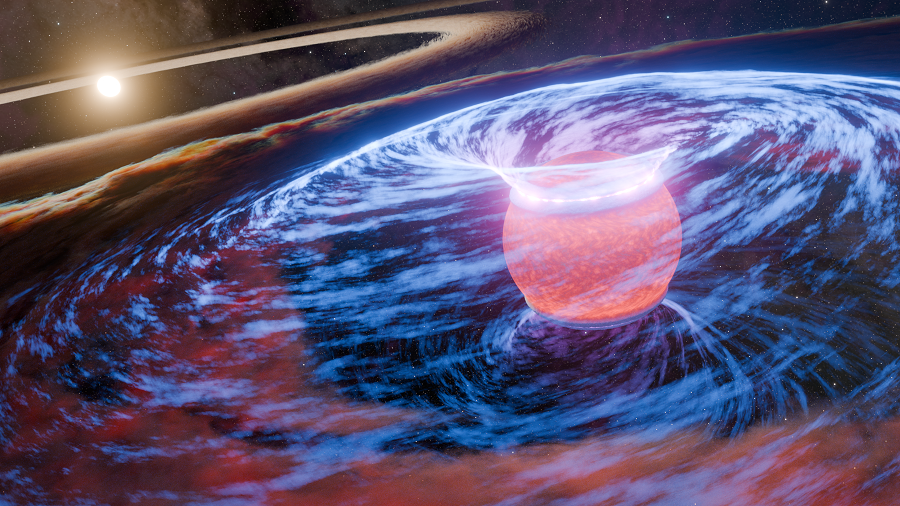
Astronomers have done something incredible — they’ve actually photographed a new planet in the making. The object, called WISPIT 2b, is what scientists call a protoplanet — a young, still-forming world that’s gathering material from the cloud of gas and dust around its parent star.
Even though it’s still in its “baby” stage, WISPIT 2b is already a gas giant about five times the size of Jupiter. It’s also astonishingly young — just 5 million years old, compared to Earth’s 4.5 billion years. The system sits around 437 light-years away from us.
A Planet in the Middle of a Cosmic Construction Zone
What makes this discovery so special isn’t just that scientists found a newborn planet. It’s where they found it — right inside a gap in a protoplanetary disk.
Think of a protoplanetary disk as a cosmic pancake made of gas and dust swirling around a young star. Over time, that’s where planets form. But these disks often have “gaps” or clear rings — empty spaces where the material seems to be missing. For years, astronomers suspected that forming planets were responsible for these gaps, pushing material outward as they grew.
Now, with WISPIT 2b, we finally have direct evidence. This planet was spotted sitting right in one of those gaps, confirming what scientists had long theorized: these young giants carve out the empty spaces themselves as they form.
A Direct Image of a Baby Planet
This breakthrough came thanks to MagAO-X, a high-tech imaging system on the Magellan Clay Telescope at Chile’s Las Campanas Observatory, run by the University of Arizona.
Unlike most planet detections — which rely on indirect methods like measuring starlight wobbles or dimming — MagAO-X captured an actual image of WISPIT 2b. Using what’s called Hydrogen-alpha (H-alpha) light, which glows when hot hydrogen gas falls onto a growing planet, astronomers were able to see the planet as a glowing dot inside the dark ring of its disk.
In other words, this isn’t just a detection — it’s a snapshot of planetary formation in progress.
Astronomers: A Second Baby Planet May Be Forming Nearby
As if one newborn planet weren’t exciting enough, the team also spotted another faint dot closer to the star WISPIT 2, which could be another forming planet. Further studies will confirm whether that’s the case — but if so, we’re looking at a multi-planet system being born before our eyes.
Who Made the Discovery
The discovery was led by University of Arizona astronomer Laird Close and Richelle van Capelleveen, a graduate student at Leiden Observatory in the Netherlands. It builds on earlier work by van Capelleveen, who first identified the WISPIT 2 disk and its striking ring gaps using the European Southern Observatory’s Very Large Telescope (VLT) in Chile.
Their findings are published in The Astrophysical Journal Letters in a paper titled “Wide Separation Planets in Time (WISPIT): Discovery of a Gap Hα Protoplanet WISPIT 2b with MagAO-X.”
The research was supported by NASA’s Exoplanet Research Program, the U.S. National Science Foundation, and the Heising-Simons Foundation.
Why It Matters
For decades, scientists have theorized how planets like Jupiter and Saturn may have shaped our own solar system’s early disk — but they’ve never been able to see that process happening in real time. WISPIT 2b gives us that chance.
In essence, astronomers have caught a planet in the act of being born — and it’s a spectacular reminder that the universe is still building worlds.
About The Author




One thought on “Astronomers Snap Photo of a Growing Giant Planet, WISPIT 2b — A Baby World Five Times Bigger Than Jupiter”