
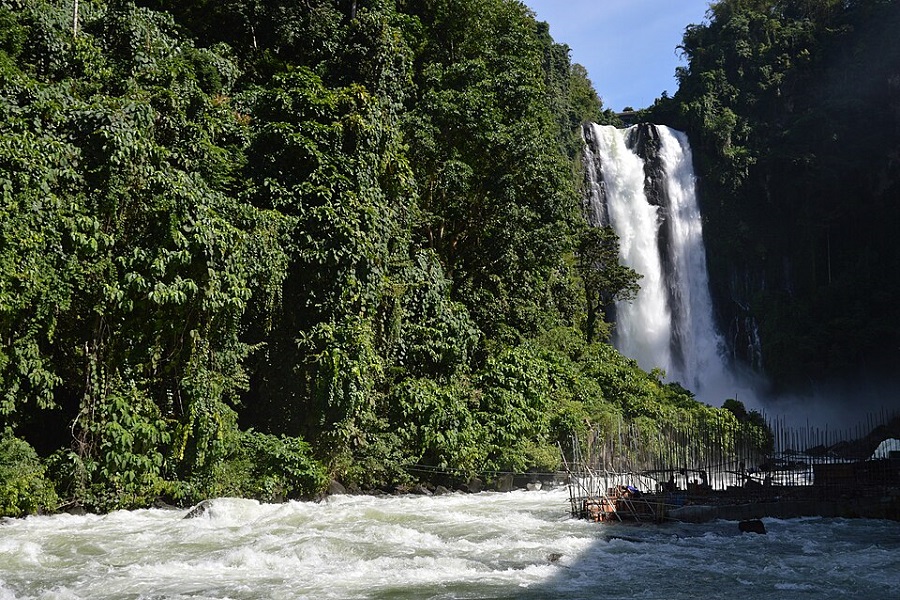
Maria Cristina Falls is an integral part of the Agus River system in the Agus-Pulangi Hydroelectric Complex (APHC). It serves as the spectacular final drop in the chain of cascading hydropower plants along the Agus River. (Image: Wikimedia Creative Commons)
Mindanao’s electric cooperatives issued a forceful warning this week against proposals that could place the region’s largest hydropower assets under private control, arguing that the government should not decide the future of the Agus–Pulangi Hydroelectric Complex without the participation of the communities that have long depended on it.
At an Inter-Agency Mindanao Power Coordination Meeting convened June 3 by the Department of Energy and the Mindanao Development Authority, leaders of Mindanao’s electric cooperatives pressed government officials to ensure that any decision involving the Agus–Pulangi system includes the voices of electricity consumers and distribution utilities across the island.
Speaking on behalf of the cooperatives, Jose Raul A. Saniel, a general manager representing the sector, delivered what participants described as a detailed position paper on the future of the hydropower complex, a decades-old network of dams and generating facilities that supplies a significant share of Mindanao’s electricity.
Government urged to hear ECs
Saniel said they intended the presentation not to obstruct government plans but to formally place on record the position of the electric cooperatives, which serve millions of consumers across urban centers, rural communities, and geographically isolated areas.
“The electric cooperatives must not only be heard, but meaningfully included,” he argued. He stressed that electric cooperatives are among the most consequential stakeholders in Mindanao’s energy future.
The intervention comes as discussions continue over the long-term management and rehabilitation of the Agus–Pulangi Hydroelectric Complex, a strategic energy asset that has become central to debates over power security, infrastructure modernization and the role of private investment in the energy sector.
The complex is a major power source for Mindanao. It draws water primarily from Lake Lanao, a large natural lake, and the Pulangi River system. It straddles provinces in the Bangsamoro Autonomous Region in Muslim Mindanao (BARMM) and other areas of Mindanao.
Cooperative leaders framed their position as an alternative to privatization, presenting proposals that they grounded in existing laws, reform frameworks, rehabilitation plans, and consumer-protection mechanisms. They argued that the hydropower facilities should remain under arrangements that preserve public accountability while ensuring reliable and affordable electricity.
For decades, electric cooperatives have been responsible for extending power services to some of Mindanao’s most remote communities, often operating in mountainous terrain, island municipalities and conflict-affected areas where commercial utilities have little presence. Because of that experience, cooperative leaders contend that they bring a consumer-centered perspective often absent from high-level policy discussions.
Push Against Privatization of Agus-Pulangi Hydroelectric Complex
The debate is centered on whether the future management of Agus–Pulangi should involve concession arrangements that would transfer operational control to private entities. Cooperative officials rejected the description of such arrangements as mere concessions. They argued that they represent a form of privatization involving the transfer of a strategic public asset into private hands.
Electric cooperative officials called for broader public consultation before the government adopts any major policy shift. For them, the stakes extend beyond ownership structures, describing the Agus–Pulangi system as the backbone of Mindanao’s energy network. It is an asset they say that continues to generate electricity, support economic activity, and help stabilize power costs across the island.
“Agus–Pulangi is not an ordinary asset,” the cooperative position stated. “It is Mindanao’s bloodstream.”
As the national government weighs options for the complex’s future, the debate underscores a larger question confronting the Philippines’ energy sector: who should control critical infrastructure that millions depend upon, and how should the government represent the public when making those decisions? The answer, for Mindanao’s electric cooperatives, begins with a seat at the table.
About The Author