![[UPDATED: 08/19/2026] Student Carrying Two Guns Kills Classmate and Himself in Zamboanga School Shooting as Hundreds Flee Campus](https://i0.wp.com/dailysunchronicle.com/wp-content/uploads/2026/08/adz-school-shooting.jpg?resize=150%2C150&ssl=1)


![[UPDATED: 08/19/2026] Student Carrying Two Guns Kills Classmate and Himself in Zamboanga School Shooting as Hundreds Flee Campus](https://i0.wp.com/dailysunchronicle.com/wp-content/uploads/2026/08/adz-school-shooting.jpg?fit=300%2C167&ssl=1)

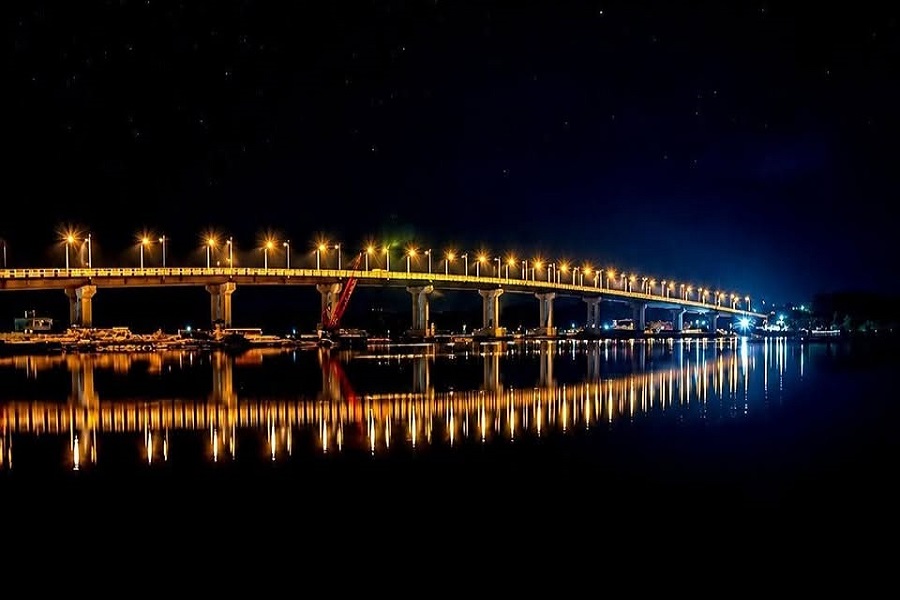
Residents of Olutanga Island have had to cross the Canalizo Strait by motorized bangka or roll-on/roll-off ferry to reach mainland Mindanao. It has been so for decades.
Now, a massive concrete bridge rising between Alicia and Mabuhay promises to change that — potentially ending one of the region’s most stubborn transportation bottlenecks and opening a new economic lifeline for the island.
The Guicam Bridge, a major infrastructure project in Zamboanga Sibugay, will connect Alicia on the mainland with Mabuhay on Olutanga Island, providing a direct road link to the three island municipalities of Mabuhay, Talusan, and Olutanga.
Once operational, the bridge could dramatically shorten travel times, improve the movement of farm and fishery products, and make it easier for residents to access schools, hospitals, government offices, and markets on the mainland.
A bridge built to transform Olutanga
The project consists of a 540.80-meter main bridge spanning the Canalizo Strait, with 12 spans of Type VI prestressed concrete girders.
Including approach roads, the overall project stretches for roughly 1.2 kilometers.
The two-lane bridge is designed with approximately 14.8 meters of navigational clearance and a 24-meter navigational width, allowing vessels to continue passing through the strait.
The price tag has also grown over the years. The project was initially placed at about ₱1.06 billion, while later figures put the cost at roughly ₱1.155 billion.
But the bridge is about more than concrete, steel, and billions of pesos.
It is intended to become a critical link for agriculture, fisheries, tourism and trade — and a major piece of the broader effort to integrate the Zamboanga Peninsula into the BIMP-EAGA growth corridor.
Where did the project come from?
The Guicam Bridge forms part of the Improving Growth Corridors in Mindanao Road Sector Project (IGCMRSP), a major road-sector program supported by an Asian Development Bank loan.
Funding was secured during the 2017–2018 period, with the ADB approving the loan in December 2017. The agreement was signed in January 2018 and became effective in March that year.
Procurement continued into 2020 before construction officially got underway.
The notice to commence was issued on January 29, 2021, with the Department of Public Works and Highways (DPWH) as the implementing agency.
Progress was slow at first, with reports putting construction at around 43 percent in the 2023–2024 period. By July 2025, however, reported accomplishment had climbed to approximately 87.9 percent, with foundation work completed and girder installation underway. Later updates placed progress at around 92 percent.
Completion targets have shifted over time, however, meaning island residents have had to wait longer than originally expected for the bridge to become fully operational.
So, who was the congressman when it all began?
This is where the political credit question comes into play.
The Guicam Bridge is located within Zamboanga Sibugay’s 1st Congressional District, which includes Alicia, Mabuhay, Olutanga, and Talusan.
When the project was being funded and prepared — and when construction finally began in January 2021 — the district’s representative was Wilter W. Palma II, popularly known as Wilter “Sharky” Palma II.
Palma II served as representative of the 1st District from June 30, 2016, to June 30, 2022, covering the 17th and 18th Congresses.
That timeline is important.
The project’s ADB financing was secured during Palma II’s congressional tenure, and construction began while he was still the district’s representative.
His father, Wilter Palma Sr., subsequently represented the district from 2022 to 2025.
Local officials and DPWH leaders have continued to promote and highlight the bridge in succeeding years, including during the Marcos administration.
But can one politician claim the bridge?
No politician can claim political credit. A project of this scale is rarely the work of a single congressman — or even a single administration.
The Guicam Bridge emerged from a long-term infrastructure program involving the Philippine government, DPWH, Congress, the ADB, local governments, and other agencies.
A congressman can push, lobby, advocate, and help secure political support for a project. But financing, engineering, procurement, contracting, and construction involve an entirely different chain of government processes.
So while Palma II was the district representative during the crucial funding and project-development period, saying he personally “built” the bridge would oversimplify how major public infrastructure projects are actually delivered.
Likewise, officials who came later can legitimately point to their role in keeping the project moving toward completion. Supporters of the incumbent congressman, Atty. Marlo Bancoro, claim the credit for the bridge. But that does not erase the decisions and financing arrangements made years earlier.
The bigger prize: Olutanga’s future
For residents of Olutanga Island, however, the political scoreboard may matter less than what happens when the bridge finally opens.
Today, crossing the Canalizo Strait can mean waiting for a boat, loading vehicles onto a ferry, or depending on weather and sea conditions.
A permanent road connection could make that ordeal a thing of the past.
Farmers could move products more quickly. Fisherfolk could reach larger markets. Businesses could transport goods with greater certainty. Tourists could reach Olutanga more easily.
And for ordinary families, a trip to the mainland could become considerably less complicated.
After years of planning, financing, delays, and construction, the Guicam Bridge is therefore more than another government infrastructure project.
It is a long-awaited road out of isolation — and potentially a new economic gateway for Olutanga Island.
The question of who deserves the political credit may continue to spark debate. But when the first vehicles finally cross the bridge, it will be the people of Mabuhay, Talusan, and Olutanga who stand to reap the biggest reward. (Facebook/Mhelz Vlog Image)
About The Author


![[UPDATED: 08/19/2026] Student Carrying Two Guns Kills Classmate and Himself in Zamboanga School Shooting as Hundreds Flee Campus](https://i0.wp.com/dailysunchronicle.com/wp-content/uploads/2026/08/adz-school-shooting.jpg?fit=640%2C356&ssl=1)