
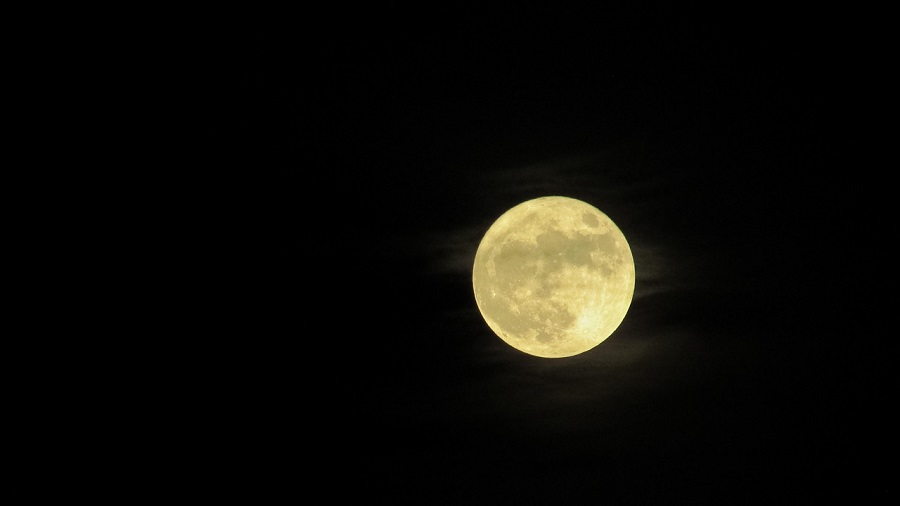
When the full moon appears unusually large and bright in the night sky, people often call it a supermoon. The sight can be striking, but there is a simple astronomical explanation behind the phenomenon.
A supermoon happens when a full moon coincides with the Moon’s closest approach to Earth, a point in its orbit called perigee.
The Moon does not travel around Earth in a perfect circle. Its orbit is slightly oval-shaped, which means its distance from our planet changes throughout the month. At its closest point, the Moon is roughly 356,000 kilometers from Earth. At its farthest, known as apogee, it can be about 406,000 kilometers away.
When a full moon occurs near perigee, it appears somewhat bigger and brighter than an ordinary full moon. This is what astronomers refer to as a supermoon.
How much bigger and brighter is it?
The difference is noticeable, but not as dramatic as some photographs might suggest.
A supermoon can appear up to about 14% larger in apparent diameter and 30% brighter than a full moon near apogee, sometimes called a micromoon.
However, the difference is not always obvious to the naked eye. Without another full moon to compare it with, many people may not immediately recognize that they are looking at a supermoon.
Why does the Moon sometimes look enormous near the horizon?
One reason people find a supermoon particularly impressive is that it often appears enormous when rising or setting.
But there is another explanation: the so-called Moon illusion.
When the Moon is close to the horizon, our brains tend to perceive it as larger because we see it alongside familiar objects such as buildings, trees and mountains. Higher in the sky, without these visual references, it may appear smaller.
In reality, the Moon’s apparent size changes very little as it moves across the sky during the night.
Does a supermoon affect Earth?
The Moon’s gravitational pull influences Earth’s oceans, producing tides.
Because a supermoon occurs when the Moon is relatively close to Earth, its gravitational influence is slightly stronger. This can contribute to higher-than-usual high tides and lower-than-usual low tides, known as perigean spring tides.
These tides are not necessarily dangerous or unusual on their own. Their actual effects depend on other factors, including local geography, weather conditions and the position of the Sun.
There is no credible scientific evidence that a supermoon causes earthquakes, volcanic eruptions or other natural disasters.
Is it safe to watch?
Absolutely. Unlike a solar eclipse, which requires special eye protection, a supermoon can be viewed with the naked eye.
Binoculars or a small telescope can make the experience more interesting by revealing lunar craters, mountains and other surface features.
For the best view, find an open area away from tall buildings and trees, preferably with a clear view of the eastern horizon during moonrise.
More than just a beautiful sight
A supermoon is a reminder of how our nearest celestial neighbor moves through space and how its changing distance from Earth affects what we see from the ground.
It may look unusually large and bright, but the Moon itself has not suddenly grown bigger. It is simply moving closer to us along its regular orbit. And sometimes, understanding the science behind a beautiful sight makes looking at it even more fascinating.
About The Author


