
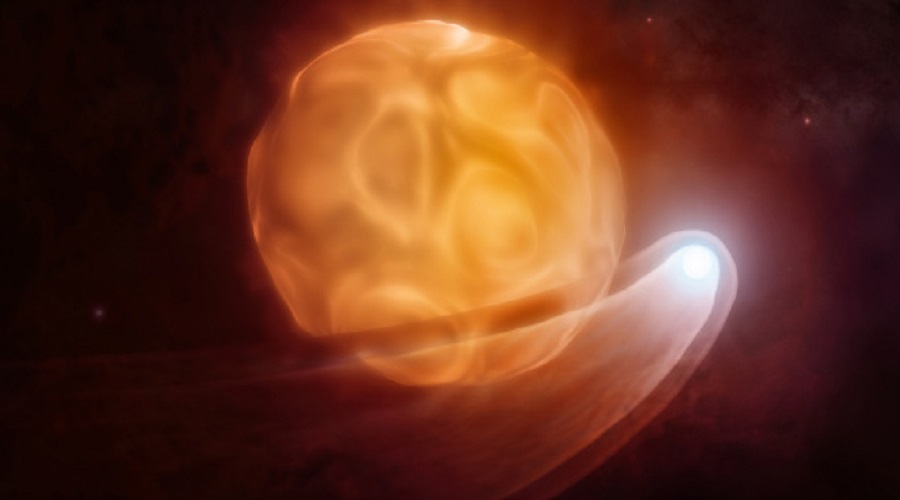
Astronomers report that Betelgeuse’s radio brightness temperatures are now back to normal following the dramatic dimming we saw in 2019 and 2020. The observations also indicate that a nearby companion star may be impacting the extended atmosphere of the red supergiant.
These are results from radio observations made between 2021 and 2026 by Dr Lynn Matthews (MIT Haystack Observatory) and her team using the VLA and the ALMA telescope.
Betelgeuse is one of the largest and brightest stars known, some 724 light years away in the constellation Orion. It was the subject of considerable interest when it underwent the Great Dimming.
This has been linked to a surface mass ejection where the star has effectively blown material off itself which is what has caused the huge change in appearance.
The research team have looked at the star’s atmospheric temperature and structure using observations at seven radio frequencies. New VLA measurements show that the brightness temperature at 22 and 44 GHz is back to normal.
At 22 GHz the peak brightness temperature is about 3,500 K which is consistent with the temperature of the star’s visible surface (the photosphere).
The researchers also found the peak occurs a little further out from the star’s centre than in previous work (about 2.7 times the radius of the star rather than the 2.5 times previously reported in studies prior to 2016).
This is consistent with a difference in the density structure of the atmosphere of Betelgeuse, but the observations don’t prove that the Great Dimming was the cause of it.
Data from the Atacama Large Millimeter/submillimeter Array enabled astronomers to look at deeper layers of the atmosphere (higher radio frequencies generally show us regions closer to the visible surface of the star).
The measurements show temperatures dropping from some 3500K at 2.7 R* down to some 2220K at 1.2 R*. This is consistent with a temperature minimum between the visible surface and the hotter chromosphere (the layer of the atmosphere above the surface).
The team also looked at whether Siwarha (the companion star thought to orbit within the extended atmosphere of Betelgeuse) could be distorting the shape of the red supergiant.
Two separate studies have now linked Siwarha to Betelgeuse’s well known variability cycle of approximately 2,100 days. Matthews and colleagues didn’t actually detect the companion, they simply looked to see if the position of the companion as predicted by the model matched up with the changes in the star’s apparent shape.
Radio images show that Betelgeuse is still pretty much round, with an ellipticity of 10% or less in all of the observed frequency bands. It’s most elongated when the companion is predicted to be at its most distant in the sky and is nearly round when the companion is crossing in front of or behind the star.
This points to the possibility that Siwarha is in some way disturbing the local environment as it moves through space, potentially impacting the region where Betelgeuse’s stellar wind (the outflow of material from the star) is thought to originate.
Matthews states that the companion passes right through the extended atmosphere of Betelgeuse as it orbits so close to the star. She likened its movement to a jet boat going through a lake, leaving a wake in its wake.
These observations provide new insight into the atmospheric structure of Betelgeuse and do suggest that the companion may have some measurable effect on the star. That said they have not actually seen Siwarha in the data so the effect is entirely an interpretation of the changes that they have observed.
The study was published in the Astronomical Journal.
About The Author