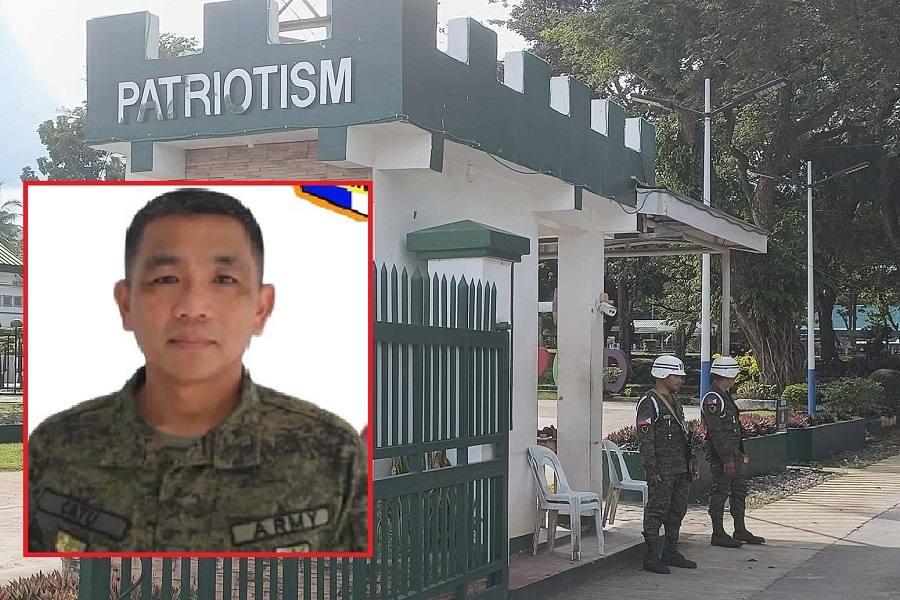
COTABATO CITY — Long before Brig. Gen. Edgar Catu took command of one of the Philippine Army’s most prominent divisions, he was a boy in Pampanga waking before dawn to sell pandesal on the streets, helping his parents put food on the table and keep his siblings in school.
He sold bread for 10 centavos apiece, calling out “Tinape! Tinape!” as he walked through his hometown of Sto. Rosario in Mexico, Pampanga. He also sold sugarcane, boiled corn, ice candy and other goods, and worked as a car wash boy to support his family.
Decades later, the lessons he learned from those early mornings — hard work, punctuality and keeping one’s word — would help shape his path to command of the Army’s 6th Infantry Division, which is responsible for security operations across the Bangsamoro Autonomous Region in Muslim Mindanao and parts of Region 12.
Catu formally assumed command Thursday at Camp Siongco in Datu Odin Sinsuat, Maguindanao del Norte, replacing Brig. Gen. Ricky Bunayog, who had served as the division’s acting commander.
Lt. Gen. Donald Gumiran, the Philippine Army chief and a former 6th ID commander, presided over the turnover ceremony.
For Catu, the appointment is more than a military milestone. It marks another chapter in a life shaped by poverty, academic excellence and years of service — a career that has brought him back to communities where peacebuilding requires an understanding of different cultures, faiths and political realities.
Lessons from selling bread
Catu was born on Feb. 3, 1972, to Ruming, a jeepney driver, and Kiring, a bread seller. The family had limited means, but his parents worked to ensure that all seven children received college educations.
Catu began earning money at about age 6. Each morning, he went to a small bakery to collect the bread he would sell that day, following the example of his mother, who taught him and his elder sisters how to attract customers and make sales.
He developed a sense of responsibility early, particularly in dealing with regular customers who bought bread on credit.
If a customer promised to pay at 5 p.m., Catu made sure he was there at the agreed time. His sisters recalled that he would sometimes argue with customers who failed to honor their commitments.
“You were the one who said and set this time for payment,” he would remind them, according to a family account of his childhood.
That insistence on honoring agreements became one of the defining lessons of his youth.
His family also found ways to earn extra income during the Christmas season, taking orders for bread from neighbors and setting up a food stall outside their local church during Simbang Gabi.
The work was demanding, but it did not prevent Catu from excelling in school.
He graduated as salutatorian of Sto. Rosario Central School and valedictorian of St. Joseph’s Academy in Mexico, Pampanga.
Although his parents had limited formal education, they succeeded in sending their children to college. The siblings went on to pursue careers in banking, engineering, medical technology, public service and other fields.
Catu’s early struggles instilled the discipline and perseverance that would later serve him in the military.
From academic achiever to military leader
A member of the Philippine Military Academy’s Marilag Class of 1995, Catu graduated among the top 10 in his class.
His military career eventually brought him to Central Mindanao, where he served in several Army units and became involved in community peacebuilding efforts in areas that now comprise Maguindanao del Norte and Maguindanao del Sur.
Those assignments exposed him to the region’s complex religious, cultural and political landscape, where military operations often intersect with government efforts to build lasting peace.
Catu has served in various capacities within the 6th Infantry Division, whose area of responsibility includes the Bangsamoro region and parts of Soccsksargen, also known as Region 12.
His familiarity with the area is significant as he assumes leadership of a division tasked not only with security operations but also with supporting peace initiatives involving local governments, communities and national agencies.
The division’s work has included efforts complementing the national government’s peace agreements with the Moro National Liberation Front and the Moro Islamic Liberation Front.
Gumiran said Catu was expected to sustain the division’s interagency and multisectoral peacebuilding programs, building on initiatives established by previous commanders.
The assignment also places Catu at the helm of a formation that has conducted operations against communist insurgents and armed groups, including Dawlah Islamiyah and the Bangsamoro Islamic Freedom Fighters.
The Army has described the 6th ID as its “fightingest” division, citing operations that it says have significantly reduced the presence of these groups within its area of responsibility. Such claims reflect the military’s assessment of its operational gains, while the longer-term challenge is sustaining security and peace in communities affected by conflict.
Leading across cultures and communities
The 6th Infantry Division’s responsibilities extend across a geographically and culturally diverse area.
Its coverage includes Maguindanao del Norte and Maguindanao del Sur, as well as Sultan Kudarat, South Cotabato, Sarangani and parts of Cotabato province. It also covers Tacurong, Koronadal and General Santos cities, along with Cotabato City’s 37 barangays.
In the Bangsamoro region, military leadership demands more than tactical experience. Commanders must work with communities shaped by distinct histories, religious traditions and experiences of conflict, while coordinating with civilian authorities and supporting peace processes.
Catu’s previous assignments in Central Mindanao give him direct experience in the region he is now expected to help secure.
His predecessor, Bunayog, also served in the division’s ranks, including as commander of the 602nd Infantry Brigade, before becoming acting division commander.
Gumiran, who previously led the 6th ID before serving as chief of the Western Mindanao Command in Zamboanga City, emphasized continuity in the division’s peacebuilding efforts.
That approach will be important in an area where military operations, civilian governance and peace initiatives must often move together to address persistent security concerns.
A family’s enduring legacy
Catu’s rise is also the story of a family that invested in education despite economic hardship.
His parents’ determination to educate all seven children gave them opportunities beyond the limits of their circumstances. Their efforts helped shape a son who would go on to graduate near the top of his military academy class and assume one of the Army’s major regional commands.
Catu is married to Nova Nyx Ecstasy “Ging” Gumana, the daughter of a former Sultan Kudarat governor. They have two children, Biboy and Bubbles.
He remains proud of his Kapampangan roots and the values instilled by his parents.
The boy who once walked the streets before dawn selling bread now commands soldiers responsible for protecting communities across southern Mindanao.
His journey from a small town in Pampanga to the leadership of the 6th Infantry Division underscores how hardship can shape discipline, how education can open doors and how early lessons in responsibility can endure long after childhood.
About The Author